 Creamfinance
 collateral factors set limits on borrowing
Creamfinance collateral is the eligible supplied balance a market values through oracle prices and collateral factors to set borrowing capacity. Market entry and caps control recognition. Outstanding debt constrains releasing that balance, while available cash and deployment restrictions can prevent withdrawals even when collateral coverage remains sufficient.
Updated ·Supplied balances need collateral eligibility
Supplying an asset and counting it toward borrowing power are distinct operations in the collateralized market design. The Comptroller governs market membership and account liquidity within its deployment. Its collateral calculation considers supplied positions in markets the account has entered.
Market membership
Owning a token in a wallet creates no collateral entry. The asset must enter the lending market, and the account must enter the relevant collateral market. In the documented Binance Smart Chain (BSC) implementation, entering a collateral-cap market also calls its collateral-registration function.
The supplier's claim
Supplying transfers the underlying asset into the market and records crTokens for the supplier. Those receipt tokens express a claim on the supplied asset. Collateral accounting converts the recognized receipt-token balance into an underlying amount before applying its price and collateral factor. A receipt-token quantity and a loan limit therefore measure different things.
Factors and oracle prices determine borrowing capacity
An eligible supplied position contributes its recognized underlying amount multiplied by its oracle price and collateral factor to borrowing capacity. The ordinary collateral calculation adds those adjusted contributions across the account's collateral markets. Oracle prices place collateral and borrowed assets into common valuation units, allowing the Comptroller to compare their values.
For one position, the relationship is
recognized underlying amount * oracle price * collateral factor
, using a fractional factor and compatible units. The factor reduces borrowing power relative to the asset's full oracle value. The selected Comptroller records the market's collateral factor, which can change, so an old percentage does not establish its present setting.
A falling collateral price reduces its contribution even when the supplied quantity stays constant. Borrowing up to the calculated capacity leaves no initial margin for that decline or additional debt interest.
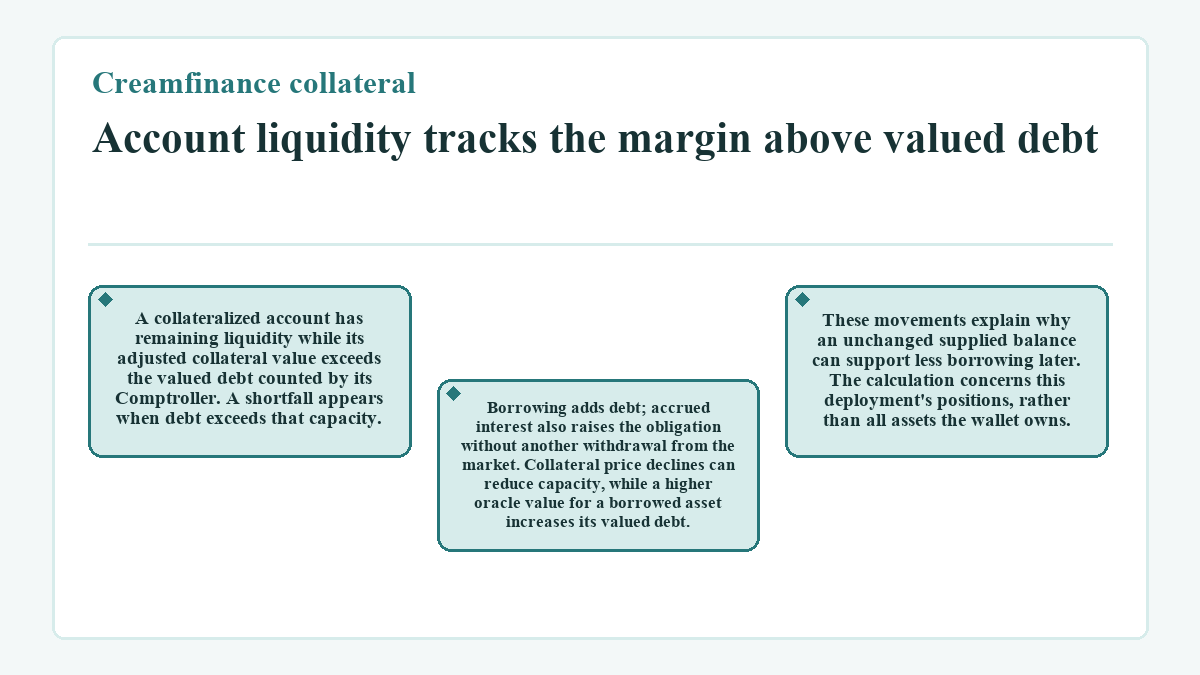
Account liquidity tracks the margin above valued debt
A collateralized account has remaining liquidity while its adjusted collateral value exceeds the valued debt counted by its Comptroller. A shortfall appears when debt exceeds that capacity. Borrowing adds debt; accrued interest also raises the obligation without another withdrawal from the market. Collateral price declines can reduce capacity, while a higher oracle value for a borrowed asset increases its valued debt. These movements explain why an unchanged supplied balance can support less borrowing later. The calculation concerns this deployment's positions, rather than all assets the wallet owns.
Market caps constrain different parts of the position
Collateral caps, supply caps and borrow caps govern different balances. Satisfying one does not satisfy the others.
Supply beyond the collateral cap
Some token implementations cap how much supplied balance they recognize as collateral. After that cap fills, further supply may remain possible without producing additional borrowing power. Collateral-cap behavior requires the corresponding market implementation; it does not follow automatically from a market listing.
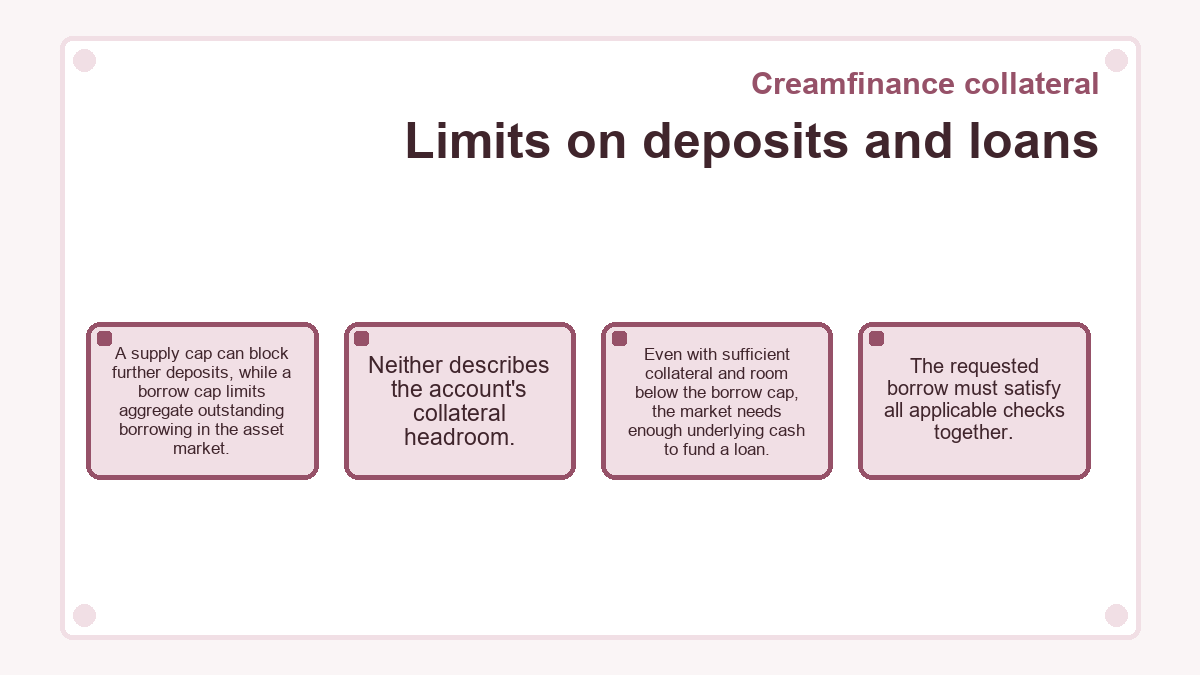
Limits on deposits and loans
A supply cap can block further deposits, while a borrow cap limits aggregate outstanding borrowing in the asset market. Neither describes the account's collateral headroom. Even with sufficient collateral and room below the borrow cap, the market needs enough underlying cash to fund a loan. The requested borrow must satisfy all applicable checks together.
Liquidation exchanges debt repayment for seized collateral
A collateralized position becomes eligible for liquidation when its account calculation shows a shortfall under the applicable market rules.
The liquidator receives crTokens
A liquidator repays borrowed assets on the account's behalf and receives collateral through seized crTokens. The liquidation incentive determines the collateral value the repayment can claim. Those receipt tokens remain a claim on their underlying market. Converting them into underlying assets still requires redemption, including sufficient market cash.
The close factor constrains repayment
The close factor limits the fraction of an individual outstanding borrow a liquidator may repay in one liquidation. It does not specify a universal fraction of the account's collateral to seize. Prices, receipt-token exchange rates and the liquidation incentive also affect the collateral quantity. These parameters belong to the applicable deployment and market state.
Debt repayment and added collateral can create withdrawal headroom
An account supporting an outstanding loan can compare repaying debt with adding eligible collateral before releasing part of its supplied balance. Both paths must leave sufficient collateral coverage after the intended withdrawal. The withdrawal market must also hold enough underlying cash; adding collateral elsewhere does not replenish its cash.
Repayment reduces the borrowed-asset obligation. Additional supply helps only when the account gains recognized collateral value. The choice therefore turns on which borrowed asset is available for repayment and whether extra collateral qualifies. The updated debt or collateral record must reflect the chosen change before the planned redemption.
- Identify the debt and collateral balances within the same Comptroller deployment.
- Choose repayment when reducing that debt supplies enough margin for the intended withdrawal.
- Choose added collateral only when membership, eligibility and applicable caps permit it to count.
- Check that the planned redemption would leave no collateral shortfall and compare the withdrawal amount with available market cash.
- Confirm the redemption through the Redeem event, the reduced crToken balance and receipt of the underlying asset.
The redemption consumes the appropriate crToken balance and transfers the underlying asset. Any debt left after that withdrawal remains an obligation of the same account.
Approved protocol credit uses a separate allowance
Whitelisted protocol credit permits borrowing through an assigned credit limit without the ordinary collateral requirement. Creamfinance's May 10, 2021 BSC announcement specified limits for individual assets. It contrasted those limits with the aggregate value limit then described for Iron Bank. An ordinary collateralized account does not acquire protocol credit simply by depositing assets or entering a market.
The Ethereum v1 exploit restricted access to collateral
Creamfinance's October 31, 2021 post-mortem reported suspending all interactions with Ethereum v1 markets following the October 27 attack. It also reported locking that deployment's crTokens against transfers. These restrictions operated separately from an individual borrower's collateral ratio.
The attack inflated yUSD collateral valuation through manipulation of its price per share. The inflated borrowing limit let the attacker extract much of the Ethereum v1 liquidity. Correct arithmetic cannot compensate for an incorrect collateral valuation input.
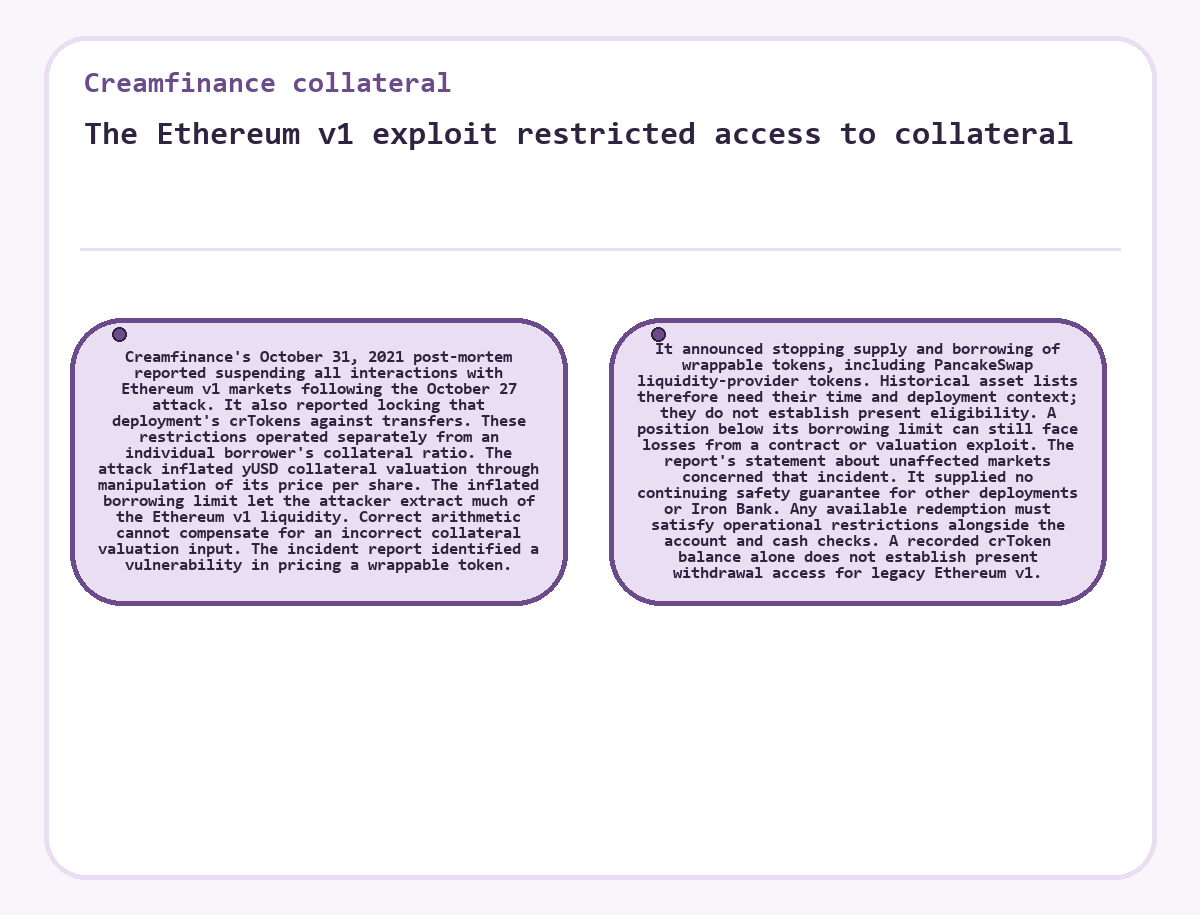
The incident report identified a vulnerability in pricing a wrappable token. It announced stopping supply and borrowing of wrappable tokens, including PancakeSwap liquidity-provider tokens. Historical asset lists therefore need their time and deployment context; they do not establish present eligibility.
A position below its borrowing limit can still face losses from a contract or valuation exploit. The report's statement about unaffected markets concerned that incident. It supplied no continuing safety guarantee for other deployments or Iron Bank.
Any available redemption must satisfy operational restrictions alongside the account and cash checks. A recorded crToken balance alone does not establish present withdrawal access for legacy Ethereum v1.
Before you start with Creamfinance collateral
-
Can a market with a zero collateral factor support my loan?
- A zero collateral factor gives that supplied asset no contribution to ordinary borrowing capacity. The asset may still have a supplied balance, subject to its market's operating rules. Supplying and collateral eligibility are separate properties. A positive token price or an interest-bearing crToken claim does not override a zero factor in the collateral calculation.
-
Is CREAM the only token accepted as Creamfinance collateral?
- Collateral eligibility is market-specific and is not limited to the CREAM token. The documented collateral-factor list includes multiple assets with different factors. That historical list does not establish which assets a particular deployment accepts today. The relevant asset must belong to the selected deployment's collateral markets, have usable collateral value and satisfy any applicable recognition cap.
-
Will transferring crTokens affect the sender's borrowing margin?
- Transferring crTokens can reduce the sender's collateral contribution when the transferred balance supports an outstanding loan. The documented BSC token implementation asks the Comptroller to authorize the transfer before changing balances. A receipt token's transfer function therefore does not imply unrestricted movement of pledged collateral. The account's remaining recognized balance governs its collateral contribution.
-
Which fields distinguish an account shortfall from a failed liquidity query?
- The documented BSC getAccountLiquidity function returns an error code, a liquidity amount and a shortfall amount. The error code determines whether the returned calculation is valid. A successful result with a positive shortfall identifies insufficient collateral coverage. A failed query does not establish either a healthy position or a liquidatable one, and zeroes alone should not substitute for checking the error result.
-
Are collateral balances shared between Ethereum and BSC deployments?
- The collateral calculation uses the positions tracked by the selected Comptroller deployment. A matching wallet address on another chain does not merge those market records. A balance supplied to a separate Ethereum or BSC deployment does not enter this calculation merely because the account owns it. The relevant collateral and debt must belong to the deployment evaluating the loan.
-
Does a zero borrow cap mean the asset has no borrowing capacity?
- A zero borrow cap disables the cap check in the documented BSC Comptroller implementation. It does not remove account-liquidity checks or the requirement for enough market cash. This differs from a zero collateral factor, which gives an eligible supplied asset no collateral contribution. The two zero values govern different constraints and cannot substitute for each other.
-
How does exiting a collateral market differ from withdrawing its assets?
- Exiting a market removes it from the account's liquidity calculation; it does not itself redeem the supplied assets. The documented BSC implementation requires no outstanding borrow in that market and checks whether removing the entire supplied position would leave adequate coverage. Debt in another market can therefore prevent exit when it still needs that collateral. Returning underlying assets requires redemption.
-
What separates a collateral factor from a reserve factor?
- The collateral factor governs how much an eligible supplied asset contributes to borrowing capacity. The reserve factor governs the share of accrued borrowing interest entering protocol reserves. Its calculation base is interest, not the supplier's entire deposited balance. A reserve percentage therefore cannot determine a loan limit or replace the collateral factor when evaluating the position's borrowing margin.